Cen Hun
The Romance of the Three KingdomsCen Hun is the favored eunuch of Sun Hao, who elevates him to a position of close influence and makes him, in the account of Wu’s last years, a conspicuous partner in the ruler’s abuses. As the Jin invasion advances, Cen proposes an extraordinary river defense of iron chains and spikes. When the effort to resist fails, officials identify him as a cause of the kingdom’s weakness and kill him, but Wu’s decline has become too deep for his death to reverse.
Position at Sun Hao’s Court
After Sun Xiu’s death, military officers press for Sun Hao to take the throne, and he becomes emperor in 265. The narrative soon presents his rule as cruel and violent. Cen Hun is raised as his companion in crime; when the late emperor’s prime minister, Puyang Xing, and others protest Sun Hao’s conduct, Sun Hao has them executed. Their deaths make clear the danger of opposing the ruler and help explain why complaints about his government do not readily become resistance.
Sun Hao’s policies burden the people and weaken the state: heavy taxes, the seizure of private funds and family fortunes, and demands that deepen poverty. Cen’s association with the ruler places him within this regime of oppression, although the account does not assign him individual responsibility for each measure. Lü Kai, Sun Hao’s deputy prime minister, warns that the treasury is empty, supplies will last less than a year, and officials demand resources the people cannot provide. He also contrasts the harem of Sun Quan’s reign, which numbered fewer than one hundred, with the more than one thousand women in Sun Hao’s palace. His petition calls for lighter burdens, better ministers, and reform; the wider portrait of the court makes Cen’s privileged proximity to Sun Hao part of a failing political order.
The River Defense
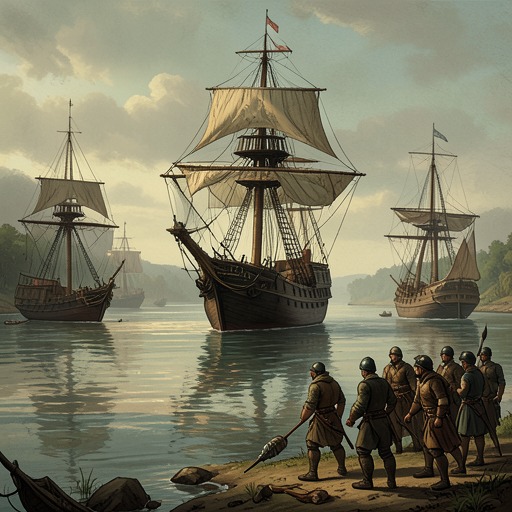
When Sima Yan launches the Jin invasion, Sun Hao is alarmed and issues orders for resistance. Returning to his private chambers, he appears troubled to Cen, who asks what worries him. Sun Hao distinguishes the land attack from the naval threat. Cen responds with a plan: iron is collected throughout the country and made into thousands of heavy chains and large spikes. The chains are stretched across the river, while the spikes are placed in its channel to obstruct the Jin ships and sink them.
The defense is a concrete attempt to answer Sun Hao’s particular fear of the navy, but it cannot prevent the invasion’s momentum. The Jin forces win an early engagement through a feigned retreat and ambush, while their troops take Xiakou by entering among fleeing Wu soldiers and setting fires inside the city. Wu commanders flee or are captured, and successive cities and regions surrender. When Admiral Wang Jun learns of the chains and submerged spikes, he sends fire ships against them. The heat melts the chains and breaks apart the spikes, allowing his fleet to continue downriver. Cen’s plan therefore becomes a striking but ineffective measure in the larger collapse of Wu’s defenses.
Blame and Death
As Jin approaches the final defenses, the scale of the disaster becomes impossible for Sun Hao to ignore. He asks why his troops will not fight. Officials answer that Cen Hun’s corruption is to blame and say they will go out to battle if the eunuch is killed. Sun Hao resists the explanation, asking whether one palace eunuch can really destroy an entire kingdom. His response exposes the crisis of judgment at court: even as his officials demand action against Cen, Sun Hao does not recognize the broader failures of his own rule.
The officials then take matters into their own hands and kill Cen. His death satisfies their demand but does not restore the army or stop the Jin advance. A storm brings down the remaining Wu banners, which many soldiers interpret as an inauspicious sign; more desert, leaving only a few brigades between Jin and victory. Wang Jun approaches Shitou, and Zhang Xiang’s surrender helps open the city gates to the Jin army. Cen’s removal thus marks a desperate, belated response to the regime’s corruption, not a remedy for the political and military breakdown already under way.
Narrative Significance
Cen’s brief but consequential role links court politics to the practical course of Wu’s defeat. He is first defined through his intimate association with Sun Hao’s cruelty and then given a specific military action: the chains and spikes meant to block the Jin fleet. Their destruction gives visible form to the limits of a court that can mobilize resources for an ambitious defense but cannot overcome disunity, weakening morale, and successive surrenders.
The accusation that Cen’s corruption has ruined the kingdom is presented as the officials’ explanation, while Sun Hao’s question challenges its sufficiency. The episode does not make Cen the sole cause of Wu’s fall: the wider account has already shown oppressive rule, impoverishment, and military collapse. His killing instead dramatizes a ruler and court confronting the consequences of that decline too late to change its outcome.